
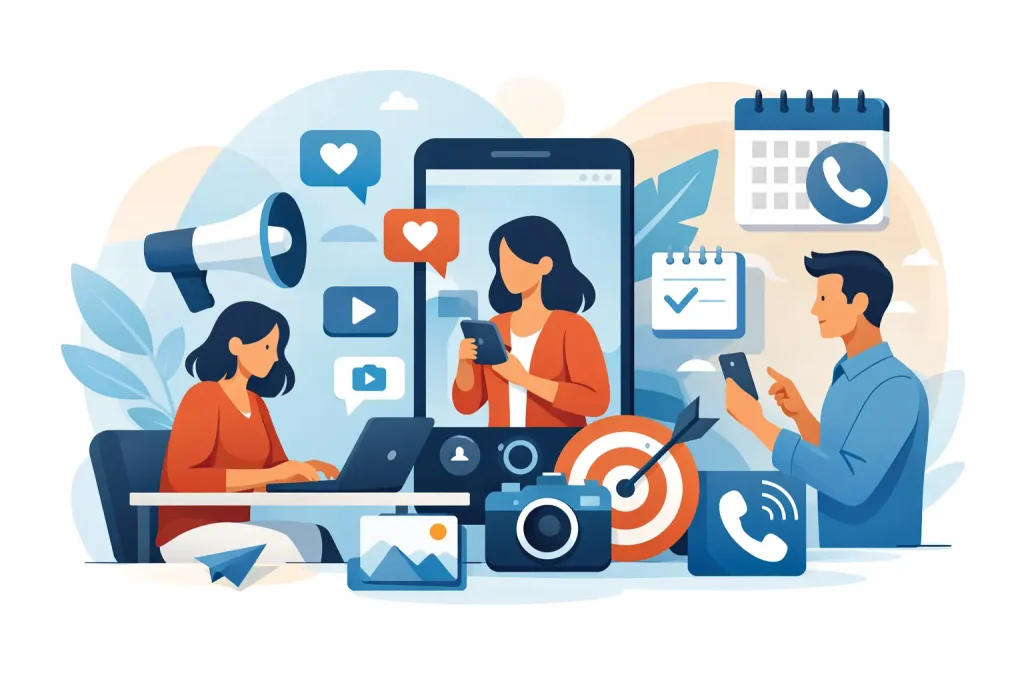
A salon owner posts a beautiful before-and-after. A consultant shares a smart business tip. A home services company uploads a job-site video. The content may earn likes, but if the next step is unclear, the attention disappears. Social media content creation for service businesses needs to do more than fill a feed. It needs to create trust, start conversations, capture intent, and move qualified prospects toward a booked call or appointment.
That does not mean every post should read like an ad. It means every post should have a job inside a larger sales system. When content, paid traffic, landing pages, automated follow-up, and booking work together, social media becomes a dependable source of pipeline rather than a weekly task with unclear results.
Why Content Alone Rarely Creates Revenue
Most businesses do not have a content problem. They have a disconnected customer journey.
A prospect might see your video, visit your profile, and think, “This is exactly what I need.” Then they have to hunt for pricing, send a message, wait for a reply, or remember to come back later. That gap is where motivated leads go cold. For appointment-driven businesses, a delayed response can mean a lost consultation, treatment booking, estimate, or sales call.
Strong content earns attention. A conversion system protects that attention.
This is especially relevant for businesses selling services with consideration involved. Someone booking EMDR therapy, comparing a med spa treatment, selecting a business consultant, or requesting a home renovation quote usually needs more than one post before taking action. They need proof, clarity, reassurance, and an easy way to take the next step.
The goal is not to make every viewer buy immediately. The goal is to give the right viewer a clear path forward and make sure your business follows up when they take it.
Build Social Media Content Creation Around Buyer Intent
Posting consistently is useful, but consistency without direction can create a polished feed that produces no meaningful demand. Start by deciding what each content category needs to accomplish at a specific stage of the buyer journey.
Awareness: Name the Problem Clearly
At the awareness stage, prospects may not know your process, your offer, or even why their current approach is failing. Your content should show that you understand their situation.
A tree planting company might explain why planting the wrong species creates expensive maintenance issues. A beauty clinic might explain why a skincare routine is not delivering the results someone expects. A B2B agency might show how slow lead response quietly reduces ad performance.
The best awareness content is specific. It replaces vague claims like “we get results” with a real observation your ideal client recognizes. Short educational videos, myth-busting posts, local insights, and problem-focused carousels work well here because they make the audience feel understood before asking for a commitment.
Consideration: Prove Your Method Works
Once someone recognizes the problem, they want evidence that your business can solve it. This is where case studies, client stories, process videos, testimonials, FAQs, and behind-the-scenes content matter.
Do not rely only on generic testimonials such as “great service” or “highly recommend.” Show the starting point, the work completed, and the outcome. For a salon, that may be a transformation with a client’s stated goal. For a consultant, it may be the operational issue and the new process that fixed it. For a home service provider, show the inspection, explanation, and completed job.
Proof must still be credible. Avoid promising results you cannot consistently deliver, particularly in health, wellness, or regulated services. Explain what influenced the result and what a new client can reasonably expect from the process. Transparent content converts better than exaggerated content because high-value buyers are looking for a partner they can trust.
Conversion: Make the Next Step Easy
Conversion content is direct. It tells the viewer what to do next and why they should do it now.
That could be an invitation to book a consultation, request an estimate, claim a treatment assessment, or send a keyword through direct message. The call to action should match the level of intent. Asking a cold audience to buy a premium package is often too aggressive. Asking them to receive a personalized recommendation, check availability, or book a no-pressure consultation can be more appropriate.
The operational detail matters here. If a prospect comments, clicks, or messages you, who responds? How fast? What happens if they do not book immediately? A content strategy without a response process leaves revenue on the table.
Use a Content Mix That Builds Trust and Demand
Service businesses often overproduce promotional posts and underproduce decision-making content. Your audience does not need to hear “Book now” every day. They need repeated reasons to believe that booking is worthwhile.
A practical monthly content mix includes four types of assets:
- Problem and educational content that attracts people dealing with the issue you solve.
- Proof content that demonstrates outcomes, expertise, reviews, and real client experiences.
- Personality and process content that shows how it feels to work with your business.
- Offer content that gives ready-to-act prospects a clear route to book, inquire, or buy.
The percentage of each depends on your market. A well-known local salon with a steady referral base can use more offer-led content. A new B2B provider selling a complex service will usually need more education and proof. If your service is sensitive, such as counseling or trauma-focused care, the content should prioritize safety, professional credibility, and clear expectations over hard-selling tactics.
You also do not need a different idea for every platform. One client success story can become a short video, a carousel explaining the process, a testimonial graphic, story content, and a longer email nurture message. Repurposing is not laziness when the message is adapted to the format and audience behavior.
Create Content From Real Sales Conversations
The fastest route to better content is usually not brainstorming from a blank page. It is reviewing the questions prospects already ask before they book.
Your reception team, sales staff, DMs, consultation notes, and recorded calls are full of content direction. Look for repeated concerns: price uncertainty, timing, fear of choosing the wrong provider, questions about results, confusion about the process, or hesitation around commitment.
Turn each recurring concern into content that answers it plainly. If prospects ask why a service costs more than a competitor, explain the difference in process, materials, qualifications, scope, or aftercare. If they wonder how long results last, explain the variables honestly. If they ask what happens in a first consultation, walk them through it.
This approach improves lead quality as well as engagement. Content that answers practical questions filters out poor-fit prospects and gives serious buyers the confidence to reach out.
Connect Content to Follow-Up, Not Just Reach
Reach is a useful signal, but it is not the finish line. A video with 20,000 views that produces no trackable inquiries may be less valuable than a post with 800 views that brings in three qualified consultations.
Track the actions that matter to your sales process: profile visits, direct messages, form submissions, calls, booked appointments, show-up rates, and closed revenue. Use those numbers to identify which topics attract people who actually convert.
Then connect your content channels to a lead response system. A prospect who fills out a form after watching a video should receive an immediate confirmation, helpful next-step information, and a simple booking option. If they do not schedule, an automated SMS and email sequence can follow up without forcing your team to manually chase every inquiry.
This is where content becomes more valuable over time. The post creates initial interest, while the workflow handles the speed and consistency that most service businesses struggle to maintain during busy hours.
Avoid the Content Mistakes That Waste Attention
The first mistake is posting only when business is slow. Content needs enough consistency to build familiarity before someone is ready to act. The second is copying trends that have no connection to your offer or ideal client. A trending sound may boost views, but it will not necessarily attract a homeowner ready for a quote or a founder ready for a strategy call.
Another common mistake is hiding the offer. Businesses sometimes focus so heavily on being helpful that prospects never learn how to work with them. Mention your service clearly, show who it is for, and explain the next step without apology.
Finally, do not judge content too quickly. Some posts generate immediate inquiries. Others create familiarity that pays off when a prospect sees your ad, visits your website later, or receives a referral. Review performance over a meaningful period, but do not keep producing content that earns vanity metrics while failing to support business goals.
Make Every Post Part of the Revenue Process
The strongest social strategy is not a calendar full of random ideas. It is a clear system: content earns attention, a compelling offer captures intent, automation responds immediately, and your team steps in when a prospect is ready for a real conversation.
FZFunnel builds these connected systems because content should not leave your team with more DMs to manage and no way to prioritize them. It should create qualified opportunities that are answered, nurtured, and guided toward the calendar.
Your next post does not need to be perfect. It needs to be useful to the right person, connected to a relevant next step, and supported by a process that does not let their interest fade while you are busy serving clients.