
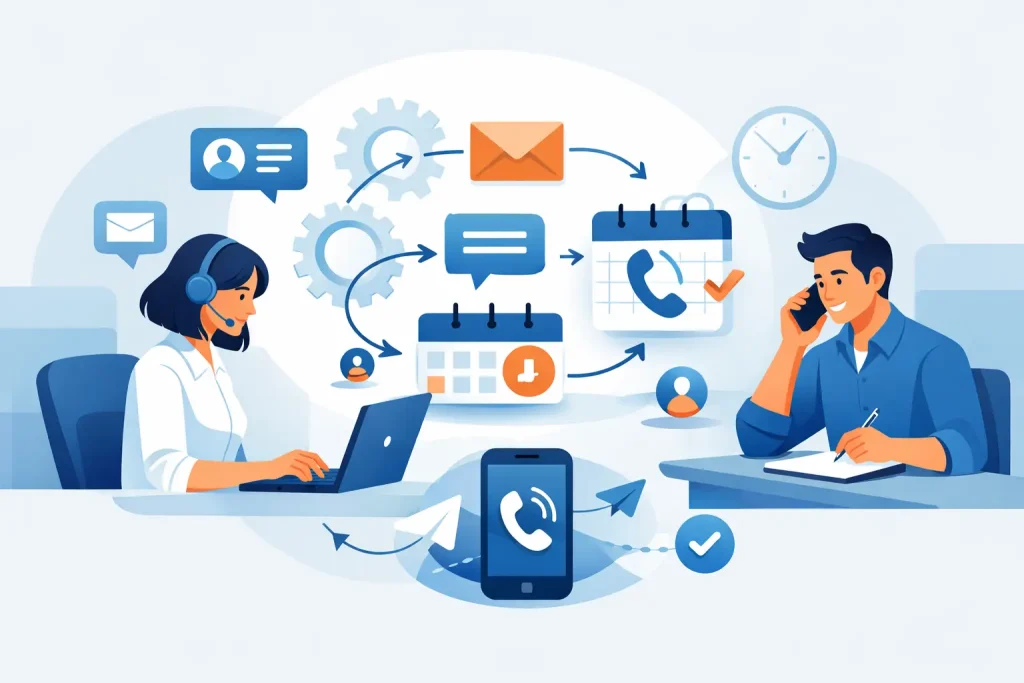
A prospect submits a form at 8:47 p.m. after seeing your ad, checks their phone, and starts comparing other providers. If your team replies the next morning, the lead may already be booked elsewhere. Learning how to automate lead follow-up is not about replacing real sales conversations. It is about making sure every qualified prospect gets a fast, relevant response before interest fades.
For service businesses, this gap is expensive. A salon inquiry, counseling consultation request, home service estimate, or B2B demo lead has already taken a meaningful step. They do not need another generic newsletter. They need clear answers, a simple next action, and a path to book when they are ready.
Start With the Lead Journey, Not the Software
Automation fails when businesses begin by building random texts and emails. The better approach is to map what happens between a new inquiry and a booked call. Look at every source of leads – paid ads, website forms, social media messages, referral forms, and chat widgets – and decide where each contact should enter your CRM.
Then define the outcomes. A high-intent lead may be ready to choose a time on your calendar immediately. A lower-intent lead might need pricing context, proof of results, or a quick qualification question first. Treating both leads exactly the same can reduce bookings and create unnecessary sales conversations.
Your follow-up system should answer four questions right away: Who is this person? What service are they interested in? How quickly do they need help? What is the best next step? Capturing those details through a short form, chat flow, or AI conversation gives your team context without creating friction for the prospect.
Build an Instant First Response
Speed-to-lead is the foundation of automated follow-up. The first message should go out within seconds of a form submission or inbound inquiry, including after business hours. This is where SMS is often effective because it is immediate and easy to respond to, but email still has a role when you need to share details, testimonials, preparation instructions, or a longer explanation of your offer.
Keep the first response specific. Instead of saying, “Thanks for contacting us,” acknowledge the action they took and give them one clear option. For example: “Thanks for requesting information about our kitchen remodeling estimates. Are you looking to start within 30 days, or are you planning ahead?” That question opens a conversation while helping you segment the lead.
For appointment-driven businesses, the first message can offer a booking link after a brief confirmation. For higher-ticket services, it may be better to ask one or two qualifying questions before presenting the calendar. The right approach depends on your sales cycle, capacity, and whether unqualified appointments are currently wasting your team’s time.
Use AI to Qualify Without Sounding Robotic
AI agents can manage the early part of a lead conversation across SMS, web chat, and social channels. They can answer common questions, collect basic details, handle simple objections, and guide prospects toward booking. That means leads can receive help at 10 p.m. on a Saturday without waiting for someone to return to the office.
The key is to give the AI clear boundaries. It should know your services, service areas, pricing parameters, availability rules, common FAQs, and when to hand the conversation to a human. It should not invent answers, promise results you cannot deliver, or handle sensitive conversations that require licensed or personal care.
This matters especially for wellness, counseling, EMDR, PTSD support, and other high-trust services. Automation can provide a timely, respectful response and help a person schedule an appropriate consultation. It should never pretend to be clinical guidance or replace the judgment of a qualified professional.
A strong AI qualification flow sounds like a helpful front desk team member, not a script. It asks only what is needed, mirrors the lead’s language, and gives the prospect a useful next step. Once the lead meets your criteria, the system should notify the right person, update the pipeline stage, and present the appointment option automatically.
Create a Follow-Up Sequence That Earns a Reply
Not every lead books after the first message. That is normal. The mistake is either stopping after one attempt or blasting people with the same reminder every day. Good automation follows up with a reason.
Your sequence can use a combination of SMS and email over several days. The timing and number of messages should reflect the urgency of your offer. An emergency plumbing inquiry needs a much shorter window than a prospect considering business coaching or a landscaping project for next season.
Each message should move the conversation forward. One can answer a common question. Another can show what happens during a consultation. A later message can create a simple choice: book now, ask a question, or tell us when to check back. If the prospect responds, the automated sequence should pause so they do not receive irrelevant reminders while your team is actively talking with them.
Avoid relying only on discounts to revive interest. A limited offer can work, but persistent price reductions can weaken your positioning. For many service businesses, reassurance, convenience, proof, and a faster path to an answer are more effective than another coupon.
Connect Every Message to Your CRM Pipeline
Automation becomes dependable when it is tied to a CRM pipeline, not scattered across inboxes. Every lead should have a visible status such as New Inquiry, Contacted, Qualified, Appointment Booked, No Show, Proposal Sent, or Closed Won. The exact stages vary by business, but the point is to make lead ownership and next actions clear.
When a contact replies, books, cancels, or goes quiet, the system should trigger the correct workflow. A booked appointment can send confirmation details, calendar reminders, and intake questions. A no-show can receive a respectful rescheduling message. A lead who asks for a quote can be routed to the right sales rep with their answers attached.
This is also how you find revenue leaks. If many people submit forms but few reach a booking page, your qualification flow or offer may need adjustment. If appointments are high but show-up rates are low, your reminders and pre-call expectations may be the issue. Automation gives you cleaner data because each action is tracked consistently.
Protect Personalization as You Scale
Automated does not have to mean impersonal. Use the details a prospect provides to make messages feel relevant: their requested service, location, desired timeline, or stated goal. A tree planting company can reference the property type. A beauty salon can reference the treatment requested. A B2B agency can route leads based on team size or service need.
However, personalization has limits. Do not use sensitive details in a way that feels intrusive, and do not overcomplicate the workflow with dozens of branches before you have proven the basics. Start with the most common paths, review real conversations, and improve the system based on what prospects actually ask.
It also helps to define when a human takes over. Automation is ideal for immediate responses, reminders, qualification, and routine questions. A live team member should step in for complex pricing discussions, unusual requests, emotionally sensitive issues, and valuable opportunities that need a more consultative approach.
Measure Booked Calls, Not Just Responses
A system can generate plenty of text replies and still fail to create revenue. Track the numbers that show whether follow-up is working: first-response time, contact rate, qualification rate, booking rate, show rate, and close rate. Review performance by lead source as well. Leads from Meta ads, Google search, organic social, and referrals often behave differently.
Watch for operational problems alongside conversion metrics. Are notifications reaching the correct person? Are leads booking outside your available service area? Are appointment slots protected from double booking? Are sales reps following up after the automated handoff? A workflow is only as strong as the process around it.
The goal is not to send more messages. It is to create a reliable lead-to-booked-call process that gives prospects a fast answer and gives your team the context to close. FZFunnel builds these connected systems around the way a service business actually sells, combining acquisition, CRM automation, AI conversations, nurture, and appointment booking into one accountable process.
Your next lead should not depend on who happens to be checking their phone. Build follow-up that responds immediately, knows when to nurture, and makes booking the obvious next move.