
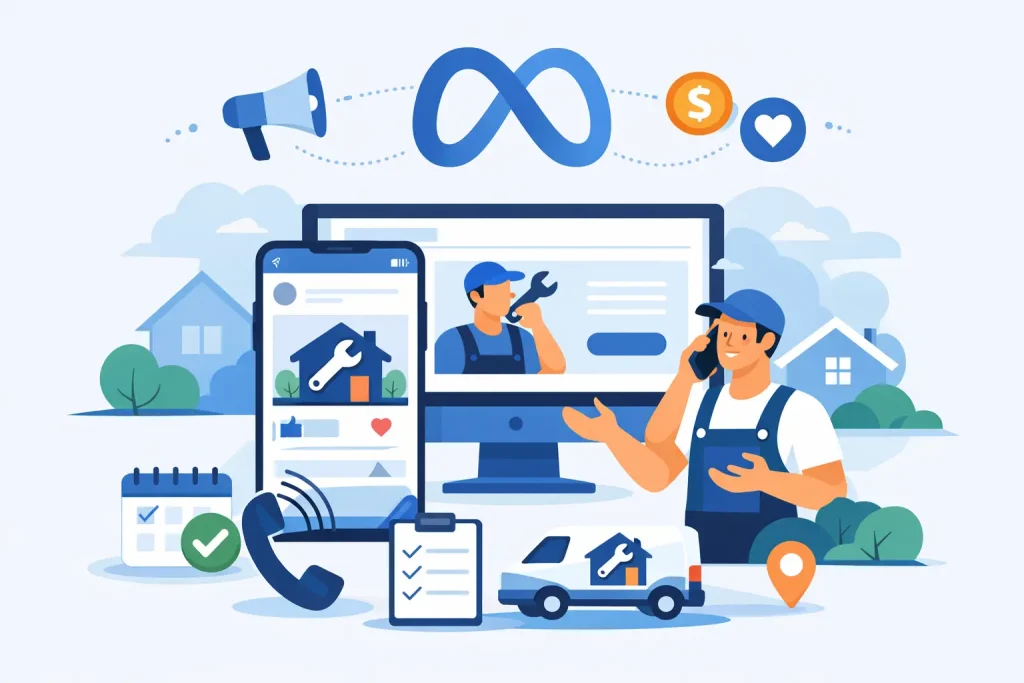
A homeowner does not open Facebook hoping to admire a plumbing ad. They open it between work, family, and a leaking water heater. If your ad appears at the right moment, Meta ads for home services can create immediate demand. But the ad is only the first handoff. If the lead waits three hours for a reply, gets a generic message, or lands in a cluttered inbox with no way to book, the opportunity is already cooling off.
For contractors and local service businesses, paid social works when it is connected to a system built for speed. The goal is not cheap form fills. The goal is qualified homeowners, property managers, or commercial buyers who receive a quick answer and move toward an estimate, consultation, or booked call.
Why Meta ads work for local service demand
Meta advertising is not intent-driven in the same way as Google Search. Someone who searches “emergency electrician near me” has a clear, active need. Someone scrolling Facebook may not be ready to hire today. That difference matters.
Yet Meta is exceptionally useful for reaching people before they start comparing five local companies. It lets home service businesses build familiarity in a defined service area, demonstrate visual proof of work, and create demand around seasonal or high-value offers. Roof replacements, landscaping projects, tree services, kitchen remodeling, pest control plans, HVAC tune-ups, and exterior cleaning all benefit from strong visual storytelling and a clear reason to act now.
The trade-off is that Meta leads often require more nurturing than search leads. A homeowner may request an estimate while busy, forget they submitted the form, or need to discuss the decision with a spouse. Treating every lead as ready to buy immediately leads to frustration. Treating every lead as a long-term prospect creates delay. Your system needs to identify where each person is and respond accordingly.
Start with the offer, not the audience settings
Many campaigns fail before targeting is even selected because the offer is too broad. “Contact us for all your home service needs” gives a prospect no reason to stop scrolling. A focused offer makes the next action easier to understand.
That does not mean every business needs a discount. For premium remodelers, a free design consultation or project feasibility call may protect positioning better than a coupon. For HVAC companies, a seasonal tune-up, maintenance-plan incentive, or priority booking window can create urgency. For tree service providers, a free risk assessment after a storm can address a specific homeowner concern.
The best offer sits at the intersection of a profitable service, a real customer pain point, and your operational capacity. Do not advertise emergency same-day service if you cannot answer the phone or dispatch a team. Paid acquisition amplifies what your business can deliver, including any weak points in the process.
Building Meta ads for home services that convert
A conversion-focused campaign has three connected parts: the message a local prospect sees, the page or form where they respond, and the follow-up that happens immediately after. Break one of those connections and cost per lead becomes a misleading metric.
Use creative that makes the work believable
Homeowners are evaluating risk as much as price. They want to know whether your team will show up, protect their property, explain the work, and solve the problem without surprises. Real job-site photos, short before-and-after videos, technician footage, customer testimonials, and clear project outcomes usually outperform polished stock imagery.
Your first few seconds should establish the problem and location relevance. A roofing company might lead with storm damage and a recognizable neighborhood type. A remodeler may show the transformation from an outdated kitchen to a finished space. A garage door company can use a direct problem statement: door stuck, spring broken, or opener not responding.
Keep the copy specific. Name the service, the service area, the desired outcome, and the next step. Avoid making claims you cannot substantiate, particularly around savings, guarantees, or limited availability. Clear ads tend to attract clearer leads.
Reduce friction without removing qualification
Native instant forms can produce volume because the prospect can submit without leaving the app. That can be useful for simple offers, especially when your team has an automated response process. However, low-friction forms can also produce leads who barely remember opting in.
Landing pages usually create more intentional inquiries because visitors see more context before submitting. They are often a better choice for high-ticket projects such as remodeling, solar, custom landscaping, or commercial service contracts. The right choice depends on your sales cycle, average job value, and response capacity.
Either way, ask only enough questions to route the lead intelligently. Name, phone number, ZIP code, service needed, and timeline are often enough. For larger projects, add budget range or project type. Do not turn a first inquiry into a 15-question application. Every extra field should earn its place by improving qualification or the sales conversation.
Speed-to-lead protects your ad spend
The most expensive home service lead is often the one you already paid for but never contacted. A new inquiry should trigger a response within minutes, not when someone finishes a job site visit or checks messages at the end of the day.
An automated text can confirm the request, set expectations, and ask one useful qualifying question. An AI agent can handle common initial replies, identify service urgency, and offer available appointment times. A human team member should take over when the situation calls for judgment, technical advice, or a high-value quote.
Automation is not an excuse to sound robotic. Messages should reference the service requested and make the next step obvious. If someone asks about a furnace repair, sending a generic “Thanks for contacting us” wastes the context they provided. A better response confirms the request, asks whether they have heat, and offers the fastest appropriate booking option.
This is where a CRM pipeline becomes operationally valuable. New leads, contacted leads, qualified estimates, booked appointments, no-shows, and won jobs need distinct stages. Without visibility, owners can mistake lead volume for growth while their team quietly loses prospects between the form and the calendar.
Measure revenue signals, not vanity metrics
Cost per lead is useful, but it cannot tell you whether a campaign is profitable. A $25 lead that books estimates and produces $8,000 jobs is far more valuable than a $10 lead that never answers the phone.
Track the path beyond the ad: lead response time, contact rate, qualification rate, booked-call rate, show rate, estimate rate, close rate, cost per booked appointment, and revenue by campaign. These numbers reveal where the real constraint is.
If your cost per lead rises but booked estimates remain strong, the campaign may still be healthy. If lead costs look excellent but contact rates collapse, the problem may be the form, the offer, or follow-up speed. If people book but do not show, confirmation messages and reminder sequences may need work. The answer is rarely “just spend more.”
For businesses with longer sales cycles, upload closed-job outcomes back into your advertising process whenever possible. That gives you a clearer picture of which campaigns produce serious buyers rather than casual inquiries. It also helps your team make better decisions about budget allocation across services and territories.
The right campaign depends on the service model
There is no universal Meta campaign that works for every contractor. An emergency plumber needs fast routing and immediate availability. A luxury landscape designer needs trust-building creative and a longer consultation path. A pest control company may benefit from recurring-service offers and renewal automation. A commercial HVAC provider may use Meta primarily to stay visible to decision-makers while Google captures urgent demand.
This is why fragmented marketing creates leaks. Ads managed in one place, forms in another, missed calls on a personal phone, and follow-up handled manually after hours do not form a dependable growth engine. FZFunnel connects paid acquisition, conversion-focused funnels, AI-assisted qualification, CRM workflows, SMS and email nurture, and calendar booking so the system handles everything before the sales conversation.
The objective is simple: give every qualified prospect a fast, relevant path to the next step. That protects your media budget, reduces manual chasing, and lets your team focus on estimates and service delivery.
A well-run home service campaign should feel less like buying attention and more like installing a reliable intake system. When a homeowner raises their hand, make it easy for them to get help while the need is still urgent.