
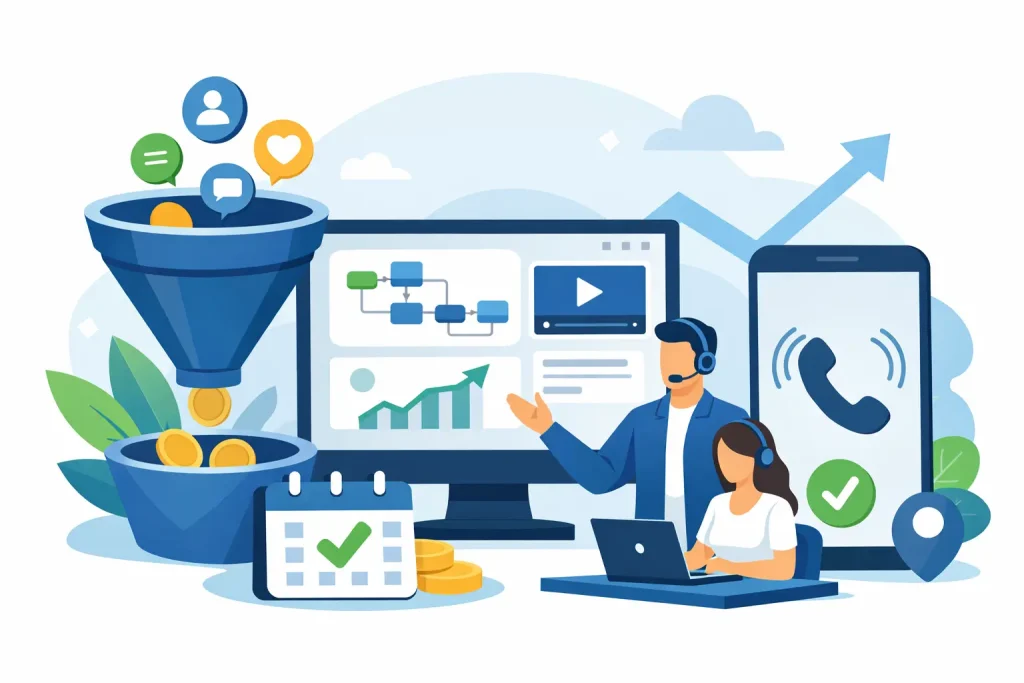
A lead filling out a form is not a sale. For a salon owner, home service company, consultant, or wellness practice, that lead is only valuable if they receive a fast reply, get the right information, and take the next step toward an appointment. A GoHighLevel funnel setup service turns those disconnected moments into one managed path from first click to booked call.
The difference is operational. Instead of paying for ads, collecting inquiries in scattered inboxes, and hoping someone follows up before interest fades, you have a system built to respond, qualify, nurture, and book. That is how marketing becomes real revenue, not just traffic.
What a GoHighLevel Funnel Setup Service Actually Includes
A funnel is often mistaken for a landing page with a form. A landing page matters, but it is only one piece of the customer journey. A complete GoHighLevel setup connects the offer, the page, the CRM, the automations, and the calendar so leads do not disappear between stages.
For example, a counseling practice may run an ad for an initial consultation. The prospect clicks through, reads a clear page built around their concern, completes a short form, and receives an immediate SMS confirming their request. An AI agent or automated workflow can ask a few qualifying questions, route the lead to the right service, and send a booking link. If they do not book, the system follows up by text and email based on their behavior.
That process should be tailored to the business. A high-ticket B2B consultant needs different qualification logic than a beauty salon promoting a treatment package. A tree planting company may need location, project size, and timeline before offering a call. The technology is flexible, but the strategy behind it cannot be generic.
The Revenue Leaks a Funnel Should Stop
Most service businesses do not have a lead problem alone. They have a follow-up problem. Leads arrive after business hours, the team is busy serving clients, or form notifications land in an inbox nobody checks quickly enough. By the time someone replies, the prospect has contacted a competitor.
A properly configured funnel addresses the points where revenue usually leaks:
- Slow responses after a form, chat, or ad inquiry
- No clear handoff between marketing and sales
- Manual lead sorting that delays qualified prospects
- Missed appointment reminders and no-show recovery
- Generic follow-up that stops after one or two attempts
- No visibility into where leads came from or why they did not book
Automation does not mean treating every prospect like a number. It gives your team the ability to respond consistently while reserving human attention for conversations that need it. For service businesses, that is a practical advantage: fewer admin tasks, fewer missed opportunities, and more time spent delivering the service clients actually pay for.
Start With the Offer, Not the Software
GoHighLevel has a wide range of capabilities, which is helpful only when the setup serves a clear commercial goal. Building workflows before defining the offer is one of the fastest ways to create a complicated system that produces weak results.
The first question is simple: what should a qualified prospect do next? Depending on the business, the answer may be book a consultation, request a quote, claim a treatment offer, complete an application, or schedule a site visit. The funnel should make that action feel logical and low-friction.
Then the message needs to match buyer intent. Cold traffic from Meta or Google typically needs more context, proof, and trust-building before asking for a booking. A referral or past lead may be ready for a direct calendar offer. The pages, automation timing, and follow-up copy should reflect that difference.
This is why a setup service should begin with your audience, sales process, and capacity. There is little value in generating 100 leads if your team can only handle 20 appointments a month. A capable partner helps align lead volume, qualification, calendar availability, and sales follow-up before scaling acquisition.
Building the Funnel From Click to Calendar
A conversion-focused GoHighLevel funnel typically begins with an ad, social post, search campaign, or direct outreach. The traffic reaches a dedicated landing page rather than a general website page with too many distractions. The page should clearly communicate who the offer is for, the outcome it helps create, and the action required.
Once a form is submitted, the system creates or updates the contact record in the CRM. It can tag the source, assign an owner, trigger an internal notification, and begin the appropriate follow-up sequence. This matters because source data tells you which campaigns bring booked calls rather than simply inexpensive form submissions.
The booking step needs equal attention. Calendars should account for team availability, appointment types, time zones, confirmation messages, and reminders. A prospect who books should receive a clear confirmation and preparation details. A prospect who abandons the booking page should receive a timely nudge, not vanish from the process.
For businesses with higher lead volume, AI agents can support the early conversation. They can answer common questions, collect information, guide people toward the right appointment type, and alert a team member when a prospect needs a human response. The goal is not to replace good salespeople. It is to make sure interested prospects are never left waiting.
CRM Pipelines Make the Sales Process Visible
A funnel without a usable pipeline becomes another black box. You may see leads coming in but have no reliable way to tell which ones were contacted, booked, qualified, won, lost, or ready for future follow-up.
A practical pipeline gives every lead a defined status. For a home service business, stages might move from new inquiry to contacted, estimate scheduled, estimate sent, won, and lost. For a wellness clinic, the stages may focus on consultation requested, intake completed, appointment booked, attended, and ongoing care.
The right stages depend on the business, but the operating principle is consistent: each stage should trigger a next action. If a lead is new, they need an immediate response. If they booked but did not attend, they need a reschedule sequence. If they received a proposal, they need structured follow-up rather than a salesperson relying on memory.
This visibility also helps owners manage performance. You can see whether the bottleneck is ad quality, landing page conversion, response time, booking rate, show rate, or closing performance. That clarity prevents the common mistake of blaming lead generation when the real issue is happening after the lead arrives.
When Automation Needs a Human Touch
Automation is strongest when it handles repeatable tasks and makes personal communication easier. It is weaker when it tries to force every buyer through the same script.
For straightforward offers, automated SMS and email follow-up can move leads quickly toward a booking. For sensitive services such as EMDR, PTSD support, or counseling, the language and timing need added care. The system should be respectful, clear about what happens next, and ready to direct urgent or complex inquiries to a qualified human team member.
Likewise, high-value B2B buyers may need a more consultative sequence than a local consumer offer. A useful funnel may deliver case examples, clarify fit, and invite a strategic call instead of pushing an immediate purchase. It depends on the decision cycle, price point, and level of trust required.
The best setup does not automate for the sake of automation. It removes delay and inconsistency while protecting the quality of the customer experience.
What to Expect From an Implementation Partner
A strong GoHighLevel funnel setup is not a template drop. It requires discovery, offer positioning, buildout, testing, and adjustment once real leads enter the system. You should expect direct communication about what is being built, why each workflow exists, and what your team needs to do after launch.
At FZFunnel, the focus is the complete lead-to-booked-call process: paid acquisition, conversion pages, CRM pipelines, AI-powered responses, SMS and email nurture, and calendar booking. The work is custom because a salon, consultant, and home service company do not sell the same way or need the same qualification path.
Before launch, every key action should be tested. Forms need to create contacts correctly. Notifications need to reach the right person. Calendar links need to work on mobile. Follow-up messages need correct timing and stop when a person books or opts out. Small errors at this stage can cost more than the time spent checking them.
After launch, performance should guide improvement. If leads click but do not convert, the offer or page may need work. If they submit forms but do not book, the follow-up or calendar experience may be the issue. If they book but do not show, reminders and pre-call communication may need refinement. Growth comes from managing the entire chain, not celebrating one metric.
A dependable funnel should leave your business with one clear standard: every qualified lead receives a useful response and a real opportunity to book, whether they arrive at 10 a.m. or 10 p.m. That consistency is where better sales operations begin.