
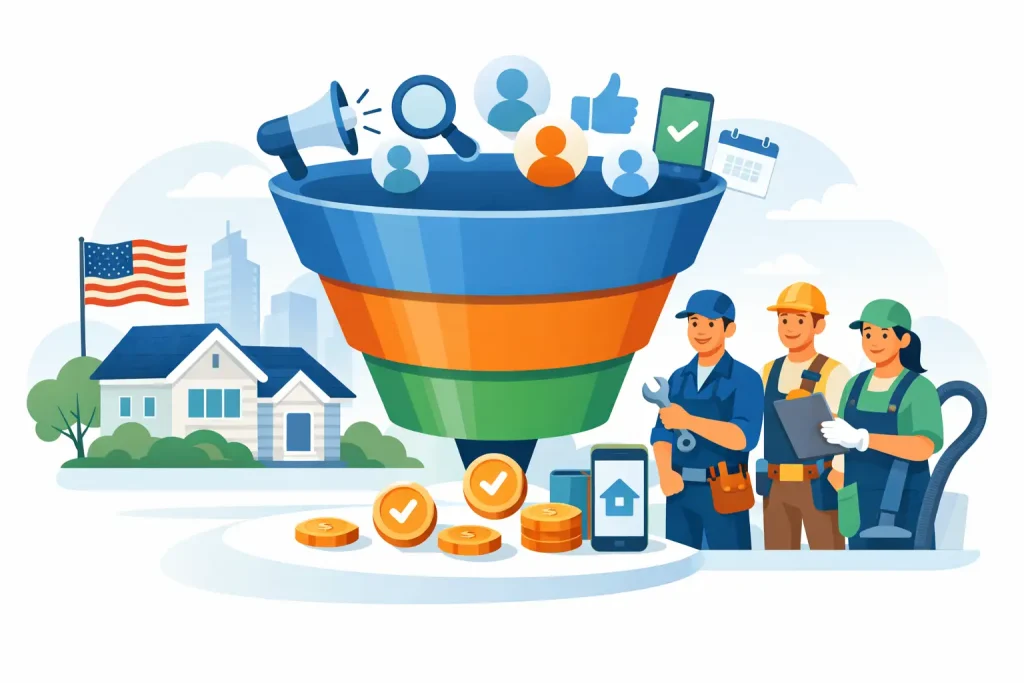
A homeowner with a leaking water heater, storm-damaged roof, or overgrown tree is not researching for fun. They want an answer quickly, reassurance that you can handle the job, and a clear next step. That is why USA home service funnels cannot stop at generating a form fill. They need to turn urgency into a qualified conversation before the prospect calls the next company on Google.
For most home service businesses, the expensive problem is not a lack of interest. It is leakage. A paid ad produces a lead, the website form lands in an inbox, a technician is on a job, and the prospect waits. Ten minutes becomes an hour. By the time someone responds, the customer has already booked an estimate elsewhere.
A profitable funnel fixes that gap. It connects acquisition, conversion, instant follow-up, qualification, and booking into one operating system built around how local customers actually make decisions.
What a Home Service Funnel Must Do
A funnel is not just a landing page with a contact form. It is the complete path from a homeowner seeing your offer to a booked estimate, service call, or consultation on your calendar.
At the awareness stage, Google Search ads capture high-intent demand such as “emergency plumber near me,” while Meta ads can create demand for services people may postpone, including landscaping, remodeling, HVAC maintenance, or tree removal. The right channel depends on the job. Emergency and repair services usually benefit from search-led campaigns because the prospect already has a problem. Higher-ticket projects often need Meta retargeting and education because the decision takes longer.
At the conversion stage, the prospect needs a page that matches the promise in the ad. If the ad offers a free roofing inspection, the page should explain the inspection, show relevant proof, establish the service area, and make the next action obvious. Sending paid traffic to a generic homepage forces people to hunt for answers. That friction costs leads you already paid to acquire.
Then comes the stage that determines whether the lead becomes revenue: response and follow-up. A complete system sends an immediate confirmation, asks the questions your team needs, offers booking options, and keeps nurturing anyone who does not schedule immediately. The point is not to replace your people. It is to make sure your people are speaking with prospects who are still interested and properly informed.
The Five Parts of USA Home Service Funnels
1. A focused offer that earns the click
“Contact us for a quote” is not an offer. It is a request for work from someone who has not yet decided you are the right choice. A stronger entry point gives the homeowner a reason to act now: same-day repair availability, a seasonal inspection, a fixed-price service range, a free estimate, or a clear financing conversation for larger projects.
The offer must fit the economics of the business. A free estimate may work well for a high-value kitchen renovation, but it can attract low-intent requests for a small repair service. In that case, a minimum job value, service-call fee, or qualifying question may protect your team’s time. More leads are not automatically better leads.
2. A landing page built for one decision
A conversion-focused home service page should answer practical questions quickly: What do you do? Who is it for? Where do you serve? Why should a homeowner trust you? What happens after they request help?
Use proof that is specific to the service. Before-and-after project photos, licensed and insured messaging where applicable, real reviews, response-time expectations, warranty details, and service-area information reduce uncertainty. For a tree service, safety credentials and cleanup process may matter most. For an HVAC company, financing, diagnostic experience, and emergency availability may carry more weight.
Keep the form short enough to complete on a phone, but useful enough to route the opportunity. Name, phone number, ZIP code, service needed, and preferred timing are often sufficient. If a long form is necessary for a major project, explain why you are asking. Every field should support qualification, scheduling, or a better customer experience.
3. Instant, useful follow-up
Speed-to-lead is a competitive advantage because local service customers frequently contact several providers. An automated SMS can confirm the request in seconds, acknowledge the service issue, and give the prospect a booking link or a simple reply path. An email can provide more detail, testimonials, preparation instructions, or answers to common concerns.
AI agents can handle the first layer of conversation around the clock: confirming location, asking about the service need, checking urgency, and guiding the prospect toward an appointment. But automation needs boundaries. It should not diagnose complex problems, make guarantees your team cannot keep, or create confusion during an emergency. The best setup knows when to notify a human immediately.
For example, a water-damage request should be flagged differently from a routine gutter-cleaning inquiry. Your pipeline, notifications, and handoff rules should reflect that difference.
4. Qualification that protects the calendar
A packed calendar is only valuable when appointments are a fit. Qualification does not mean interrogating prospects. It means collecting enough context to prioritize the right opportunity and prepare the right person.
A roofing contractor may need property type, damage type, insurance status, and location. A remodeling company may need budget range, project scope, timeline, and decision-maker availability. An electrical service business may need to know whether the issue is urgent and whether the customer owns the property.
This information should enter the CRM automatically, tagged by service, campaign, location, and lead status. Without that structure, a growing business ends up with a spreadsheet, text messages, missed calls, and no reliable view of where opportunities are stuck. With it, your team can see which ads create booked estimates, which services create the highest value, and where follow-up needs attention.
5. Consistent nurture after the first contact
Not every homeowner books on the first visit. Some need to check with a spouse, compare estimates, wait for a payday, or simply get distracted. That does not make them a dead lead.
A practical nurture sequence follows up through text and email with a clear purpose. It can remind them to schedule, share relevant project proof, address financing or timing concerns, and ask whether they still need help. The message should feel connected to the service they requested, not like a generic marketing blast.
Frequency matters. Too little follow-up leaves money on the table. Too much can damage trust, especially when a customer has already said they are not moving forward. Build stop conditions into the workflow, honor opt-outs, and make sure SMS consent practices meet applicable requirements. Good automation is persistent, not careless.
Measure Revenue, Not Just Leads
A campaign that produces 100 leads is not necessarily better than one that produces 30. If the first campaign delivers unqualified price shoppers and the second produces 12 booked estimates in your ideal service area, the smaller number can be far more valuable.
Track the full path: cost per lead, contact rate, qualification rate, booking rate, show rate, close rate, average job value, and revenue by source. These numbers reveal what to fix. A low conversion rate on the page may point to a weak offer or unclear message. Strong form submissions but poor contact rates usually point to slow response, wrong phone numbers, or weak follow-up. High booking rates with low close rates may indicate an expectation gap between the ad and the sales conversation.
This is why disconnected marketing creates expensive blind spots. An ad agency may report cheap leads while your office reports poor jobs. Both can be telling the truth because neither is measuring the whole system.
Build for the Way Your Team Actually Works
The best funnel is not the most complicated one. It is the one your office can operate consistently while technicians are in the field and demand changes by season.
That may mean a simple Google Ads to landing page to SMS booking workflow for a local repair company. It may mean Meta lead ads, a qualification chatbot, retargeting, and a multi-step consultation sequence for a premium renovation business. The right design depends on your sales cycle, service radius, capacity, job value, and how quickly your team can respond.
At FZFunnel, we build these systems as connected lead-to-booked-call operations, not isolated pages or ad campaigns. The goal is straightforward: make every serious inquiry easier to capture, easier to follow up, and easier to move onto the right calendar.
The next homeowner who clicks your ad is already looking for a solution. Give them a fast answer, a clear path, and a reason to book before your competitor gets the chance.