
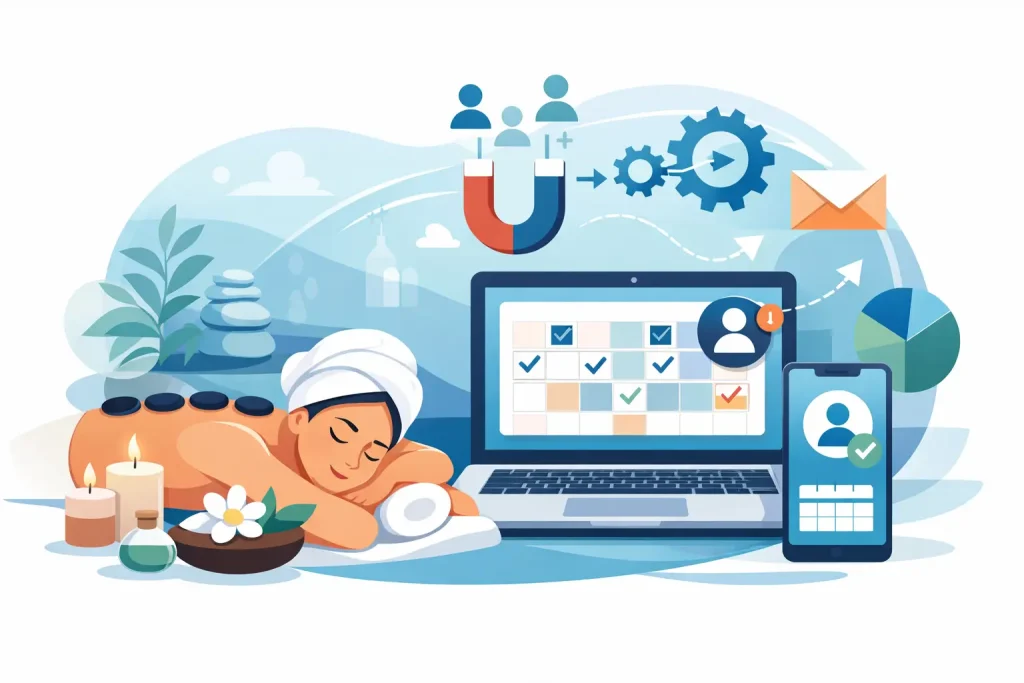
A prospective client sees your facial offer at 9:40 p.m., submits a form, and gets no response until the next morning. By then, she has booked with the spa that texted back in 60 seconds. That is the revenue problem spa lead generation automation is built to solve.
For a spa, leads are rarely just names in a spreadsheet. They are people comparing services, checking availability, weighing price, and deciding whether they trust your team with their skin, body, and time. Fast, personal follow-up is not an administrative nice-to-have. It is part of the sales experience.
The goal is not to replace your front desk with software. It is to build a dependable system that responds, qualifies, nurtures, and books prospects before interest disappears – while your team stays focused on delivering an excellent in-spa experience.
Why spas lose leads before the consultation
Most spa owners do not have a lead problem. They have a follow-up gap.
A paid ad generates a consultation request. An Instagram message asks about a body contouring package. A website visitor downloads a bridal spa menu. Each inquiry enters through a different channel, often at a time when the team is serving clients, handling checkouts, or closing for the evening. The lead may be seen later, but later is often too late.
The second issue is inconsistency. One prospect receives a thoughtful reply within minutes. Another receives a generic message two days later. A third is called once, does not answer, and never hears from the business again. This creates an unpredictable sales pipeline, even when advertising is working.
High-ticket treatments make the problem more expensive. Services such as laser treatments, body sculpting, advanced facials, memberships, injectables where permitted, and wellness packages often require education and trust before a booking. A single missed follow-up can mean losing hundreds or thousands of dollars in potential client value.
Automation closes the gap by making the next action automatic. Every new inquiry receives a response. Every prospect is assigned a clear stage. Every unbooked lead receives appropriate reminders and answers until they book, opt out, or need a team member to take over.
What spa lead generation automation should actually do
A useful system connects acquisition, conversion, communication, and booking. It should not be a collection of disconnected tools that adds more work to your team.
At the top of the funnel, ads, social content, referral campaigns, and search traffic send prospective clients to a focused landing page or lead form. The offer must match the audience. A first-time facial promotion, skin consultation, lymphatic drainage package, or membership trial each needs its own message, questions, and follow-up path.
Once a prospect submits their details, the system should send an immediate SMS and email response. The first message should feel helpful, not robotic: confirm their inquiry, answer the most common next question, and give them one clear path to book. If they requested a consultation, the booking link should be available right away.
From there, automation should qualify the lead with a few practical questions. What service are they interested in? What result are they hoping for? Are they a new or existing client? What is their preferred appointment time? The right questions make follow-up more relevant without turning a simple inquiry into a long application.
A CRM pipeline then gives your team visibility. Instead of searching across inboxes, staff can see whether a lead is new, contacted, qualified, booked, showed up, purchased, or needs reactivation. This matters because automation without a clear pipeline can simply hide chaos behind scheduled messages.
Finally, the system should continue after the booking. Appointment reminders reduce no-shows. Pre-visit instructions help clients arrive prepared. Post-treatment follow-up supports reviews, rebooking, membership offers, and long-term retention.
Build the workflow around speed, not just volume
More leads will not fix slow response times. In fact, sending more traffic into an unmanaged process can make the customer experience worse.
Start with a simple standard: every web form, ad lead form, call request, and direct message should receive an acknowledgment within minutes. That does not mean every prospect needs an immediate phone call from a staff member. It means the business responds while the prospect is still engaged.
A strong first response can confirm the requested service, set expectations, and ask one question that moves the conversation forward. For example, a body contouring inquiry might receive a message asking which area the client wants to target, followed by a consultation booking option. A facial lead may be asked whether their priority is acne, texture, pigmentation, or anti-aging.
AI agents can handle many of these early conversations when they are trained on your actual services, pricing guidance, treatment eligibility rules, availability, and policies. They can answer routine questions around the clock and escalate anything sensitive or complex to the right person. The trade-off is clear: an AI agent is only as good as the information, guardrails, and handoff process behind it. It should never guess about clinical suitability, contraindications, or medical advice.
Create follow-up that feels personal
Prospects often need several touchpoints before booking, especially when they are considering a higher-value treatment. Silence after the first message does not automatically mean a lead is not interested. They may be at work, comparing options, waiting for payday, or unsure which service fits their goals.
This is where multi-channel nurture earns its place. A thoughtful sequence can use SMS for speed, email for details, and calls for higher-intent leads. The messaging should change based on what the prospect does. Someone who clicked a booking link but did not schedule needs a different message than someone who never opened the first email.
Avoid sending the same discount repeatedly. Price incentives can generate action, but they can also train your audience to wait for the next promotion. For premium spas, education, treatment outcomes, social proof, availability, and a clear consultation process often convert better than constant discounting.
Your nurture sequence should answer the objections your staff hears every week: how long the treatment takes, what downtime may be involved, how many sessions are usually needed, what to expect at a consultation, and whether financing or packages are available. Keep the language clear and accurate. The purpose is to reduce uncertainty, not pressure someone into booking.
Use booking automation without losing the human touch
Online booking is powerful because it lets a motivated prospect act immediately. But not every spa service should use the same booking path.
A straightforward massage, facial, or membership appointment may go directly to a service calendar. A high-value or personalized service may be better routed through a consultation calendar first. That distinction protects your staff from unqualified appointments and helps clients receive an appropriate recommendation.
Calendar automation should include confirmation messages, reminders, rescheduling links, and internal notifications. If a prospect books a consultation, the system can send an intake form and a short explanation of what to bring or expect. If they cancel, an automated message can offer an easy route to rebook rather than allowing the opportunity to disappear.
The human handoff still matters. A lead who asks an unusual question, has multiple concerns, or shows strong purchase intent may need a timely call or personal message. Automation creates the signal. Your team closes the conversation with expertise and care.
Measure the numbers that reveal revenue leakage
Vanity metrics will not tell you whether your funnel is working. Impressions and likes can be useful indicators, but they do not show whether the spa is turning inquiries into revenue.
Track lead source, cost per lead, speed to first response, contact rate, consultation booking rate, show rate, close rate, average client value, and rebooking rate. Review these numbers by service line when possible. A campaign producing inexpensive facial leads may perform very differently from one promoting body sculpting consultations.
Also look at where leads stall. If many people submit forms but do not reply, the offer or first message may need work. If they book but do not show, reminders and pre-appointment communication may be weak. If consultations happen but sales lag, the issue may be qualification, pricing clarity, or the in-person consultation process – not the ads.
This is why FZFunnel approaches automation as a full lead-to-booked-call system rather than a standalone funnel or ad campaign. The handoffs between channels are where many otherwise good opportunities are lost.
A practical rollout plan for spa owners
Do not automate every process at once. Begin with the highest-value gap: instant response to new leads. Connect your lead sources to one CRM, create a clean pipeline, and make sure every inquiry gets a helpful first message and a booking opportunity.
Next, build a short follow-up sequence for leads who do not book. Add appointment reminders and a simple no-show recovery workflow. Once those foundations are producing consistent results, introduce deeper qualification, AI conversation support, treatment-specific campaigns, and reactivation for past inquiries.
Before launching, test the system as if you were a client. Submit a form after hours. Ask a common question. Try to reschedule. See whether the messages sound like your spa and whether a real person can step in quickly when needed. A workflow that looks good on a diagram can still create friction in a real conversation.
The best automation does not make your spa feel less personal. It gives every interested client the fast, organized response they expected when they reached out – and gives your team more time to deliver the care that keeps them coming back.