
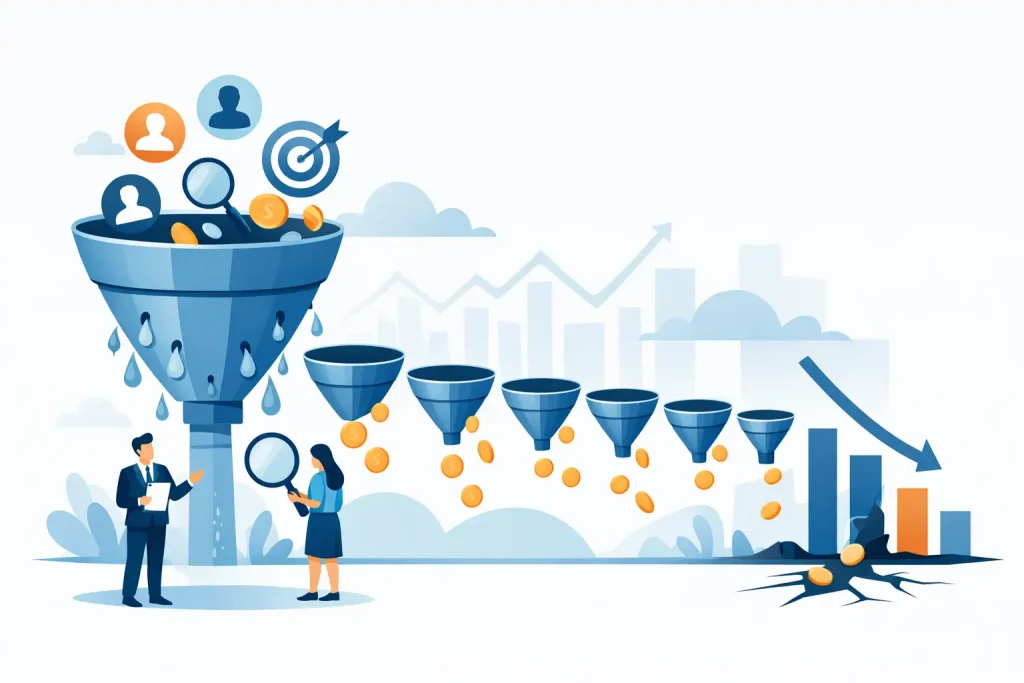
A prospect requests a quote at 7:14 p.m., gets no reply until the next afternoon, and books with a competitor before your team opens the CRM. That is lead leakage in its most expensive form. If you are asking what causes lead leakage, the answer is rarely a lack of leads. It is usually a broken handoff between initial interest and a real sales conversation.
For a salon, that may look like an Instagram inquiry that never reaches the booking calendar. For a home service company, it may be a missed call that receives no text-back. For a consultant or wellness practice, it may be a prospect who downloads a guide, receives one generic email, and is never asked to book a call.
The frustrating part is that these losses are often invisible. Ad platforms report leads. Your team remembers the appointments that happened. But the leads that quietly went cold are not counted as lost revenue, even though you paid to acquire them.
What Causes Lead Leakage in Service Businesses?
Lead leakage happens when a potential customer enters your business but does not receive the speed, clarity, or follow-up needed to take the next step. It can occur before a lead reaches your CRM, while they are waiting for a response, during qualification, or at the point of booking.
The cause is often a system problem, not an effort problem. Your staff may care deeply about customers and still miss leads when messages live across Facebook, Google ads, website forms, email inboxes, phone calls, and direct messages. A business can have strong demand and still lose opportunities because its process depends on someone noticing, remembering, and responding at exactly the right moment.
Here are the eight gaps that create the most avoidable revenue loss.
1. Slow First Responses
Speed-to-lead has a direct effect on whether a prospect engages. Someone searching for an emergency plumber, a skin treatment, counseling support, or a business consultant is usually comparing options in real time. If your reply arrives hours later, you are no longer responding to an active conversation. You are trying to restart one.
The issue is not that every lead needs a full sales call within 60 seconds. It is that every lead needs immediate confirmation that they have reached a real, responsive business. An instant SMS or email that acknowledges the inquiry, answers a common next question, and offers a booking path can hold attention while a human takes over when needed.
Response speed matters most for high-intent leads. A long-term nurture sequence can work well for someone researching a future project, but it will not rescue a prospect who needs an appointment this week and has three other providers open in their browser.
2. Lead Sources That Are Not Connected
Many businesses collect leads in more places than they realize: website forms, Meta lead forms, Google ads, calls, WhatsApp, Instagram, referral forms, chat widgets, and booking requests. When each source lands in a different inbox or spreadsheet, visibility disappears.
A lead is easily lost when there is no single source of truth. One team member may assume another person replied. A form notification may be buried under promotions. A social media inquiry may stay unread over a weekend. None of this looks like a dramatic failure, but each small gap adds up.
A connected CRM pipeline prevents that fragmentation. Every inquiry should create a contact record, trigger the right response, show its source, and move through a visible sales stage. That does not mean treating every person identically. It means ensuring no lead depends on a manual copy-and-paste process to receive attention.
3. No Clear Ownership or Routing
A lead that belongs to everyone often belongs to no one. This is common in growing service businesses where the owner, receptionist, salesperson, technician, or account manager all handle inquiries at different times.
Routing should reflect the type of inquiry. A new patient inquiry may need an intake coordinator. A high-value B2B request may need to go directly to the founder or closer. A returning customer may need customer support rather than a new sales workflow. Without rules, leads get forwarded through internal messages, delayed, or answered without context.
The fix is not always adding more staff. It is defining what happens next. Assign an owner, set response expectations, and build escalation rules for leads that have not been contacted. If an assigned rep does not respond within a set window, the system should notify a manager or reassign the opportunity.
4. One Follow-Up Attempt and Then Silence
Most prospects do not book after the first message. They may be busy, comparing options, waiting for a paycheck, discussing the decision with a partner, or simply distracted. Silence does not always mean disinterest.
Yet many businesses send one email or make one call, then move on. That leaves money on the table, especially when the original inquiry demonstrated clear intent. Consistent follow-up is not about pestering people. It is about being useful, relevant, and easy to reach when they are ready.
A practical nurture sequence can combine a confirmation message, a short reminder, answers to common objections, a testimonial or proof point, and a final prompt to book. SMS works especially well for time-sensitive appointment businesses, while email can carry more detail for complex or high-ticket decisions. The right mix depends on your offer, audience, consent requirements, and sales cycle.
5. Booking Friction at the Moment of Intent
A prospect can be interested, qualified, and ready to talk, then disappear because booking requires too much effort. Asking them to call during business hours, wait for an email reply, fill out a second form, or navigate an unclear calendar creates unnecessary drop-off.
Your booking process should match the decision. For simple consultations, let qualified leads choose a time from a calendar immediately. For more complex services, use a short qualification form before presenting available slots. The goal is not to automate every interaction. The goal is to remove administrative friction without removing the human judgment your sales process needs.
Also look at the small details: Are there enough appointment slots? Does the calendar work properly on mobile? Are time zones clear? Does the confirmation message explain what happens next? A booked call is more likely to show when the prospect receives clear expectations and timely reminders.
6. Weak Qualification and Incomplete Lead Data
Not every inquiry is a sales-ready opportunity, but poor data makes it impossible to tell the difference. If your form captures only a name and email, your team may spend time chasing leads with no budget, wrong location, or no fit for the service.
Ask only for information that helps determine the next action. A home service business may need service type, property location, and urgency. A B2B agency may need company size, core challenge, and monthly budget range. A wellness provider may need preferred service and availability, while keeping sensitive questions appropriate and compliant.
Too many fields can lower form conversions. Too few fields can flood the pipeline with ambiguity. The best balance depends on the value of the appointment and the amount of sales effort required after the lead arrives.
7. Marketing and Sales Operate as Separate Systems
Advertising can generate attention, but ads alone do not create booked calls. When the marketing team is measured only on cost per lead and the sales team is measured only on closed deals, neither side has a full view of what happens in between.
This creates a familiar pattern: the agency says leads were delivered, the owner says the leads were poor, and nobody can see whether the real problem was response time, contact rate, qualification, booking, show rate, or closing performance.
Track the full path from source to revenue. Which campaigns generate leads that answer? Which ones book? Which ones show up? Which ones become paying customers? FZFunnel builds this connection so paid acquisition, CRM automation, AI-assisted responses, and calendar booking operate as one lead-to-call system rather than separate tools.
8. No Process for Recovering Stalled Leads
A lead who does not book today may still convert later. The same is true for no-shows, canceled consultations, incomplete forms, and prospects who replied once but stopped responding. Without reactivation workflows, these contacts become an expensive dead list.
Recovery campaigns should be specific to why the lead stalled. A no-show needs a simple rescheduling option. An incomplete form may need a reminder and a lower-friction path. A quote request that went quiet may need a check-in tied to the original service, not a generic newsletter months later.
This is where automation creates practical leverage. It can identify stalled opportunities, send timely messages, and surface engaged leads for human follow-up. Your team spends less time checking lists and more time speaking with people who are ready to move.
How to Find Lead Leakage Before Spending More on Ads
Before increasing your ad budget, trace the last 30 to 90 days of leads through your process. Review how long the first response took, whether every lead had an assigned owner, how many received more than one follow-up, and where people stopped moving forward.
Look beyond lead volume. A campaign producing fewer leads but more booked calls may be more valuable than a cheap lead source that generates little response. Similarly, a lower booking rate may point to a calendar issue, while a high booking rate with poor attendance may point to weak confirmation and reminder messages.
The most useful audit is simple: choose a sample of lost leads and ask what happened next. If the answer is unclear, that is the leak. Build a process that responds immediately, captures the right context, routes ownership, follows up consistently, and makes booking easy. Every improvement protects the demand you already worked and paid to create.